Chapter 1 — The Continuity Gap and the Case for Epistemic Identity
1.1 The unsolved problem: agent self-continuity
Continuous learning is the open frontier for large language model agents. Weights freeze when training ends; what an agent learns afterward lives only in a context window that is cleared at each compaction. The field has answered one half of this problem well — retrieval-augmented memory carries information across sessions — and has barely named the other: whether the agent itself persists. An assistant that retrieves yesterday's notes but begins each session as the same generic model remembers facts; it does not remain someone. Terms of art are collected in the Glossary (Appendix G); each entry points to the section that defines it.
We argue that agent continuity is not one problem but three progressively deeper layers, and that the current landscape essentially does not address the deepest.
- Layer 1 — Memory Persistence. Storing and retrieving facts across sessions. Retrieval-augmented agent-memory systems (A-MEM, Mem0, Zep) operate here. They have no concept of identity; they are retrieval-oriented stores with no construct of agent identity (Chhikara et al., 2025; Rasmussen et al., 2025; Xu et al., 2025).
- Layer 2 — Narrative Identity. Maintaining a coherent self-story — a creed-anchored autobiography that answers "who am I?". The closest published system, Sophia (Sun et al., 2025), reaches this layer.
- Layer 3 — Epistemic Identity. Maintaining graded self-knowledge with provenance, confidence, contradiction correction, and metacognitive self-audit: identity as the answer to "what do I know, how confidently, and on what basis?".
Each layer presupposes the one beneath it: there is no self-story without persistence, and no graded self-knowledge without a self-story to grade. This paper's contribution is at Layer 3, which no surveyed system reaches (§1.4).
That the mechanisms are missing is not our diagnosis alone, and none of the following work was surfaced by our own prior-art search (Appendix A). Two items are contemporary diagnoses of LLM agents; the third is the field's organizing framework remarking on its own gaps, a weaker kind of statement, so we keep the three distinct rather than count them together. Pink et al. (2025) operationalize episodic memory as five properties — long-term storage, explicit reasoning, single-shot learning, instance-specificity, and contextual binding — and find that no current approach to LLM memory satisfies all five. The closest, retrieval-augmented generation (RAG) and its graph variant, are marked only partial on single-shot learning and on instance-specificity; on contextual relations RAG is marked as not satisfying the property at all, and its graph variant only partially. Wray et al. (2025), reading the field through pre-transformer cognitive architectures, identify two design patterns "that have not yet been taken up in the Agentic LLM mainstream" (Wray et al., 2025, § 3.2): reconsideration (revisiting a prior commitment) and knowledge compilation. Sumers et al. (2024), whose CoALA framework is the field's common organizing vocabulary rather than a third diagnosis, note in passing that while the literature has concentrated on adding to memory, "modifying and deleting (a case of 'unlearning') are understudied" (Sumers et al., 2024, § 4.5).
None of this work names what the missing mechanisms would be for. Pink et al. argue that episodic memory is missing; they do not ask what an agent becomes once it has one. Wray et al. name reconsideration as an unexploited pattern; they do not treat an agent's capacity to be wrong about itself as constitutive of who it is. Our claim occupies that gap: assembled, the mechanisms the field has named as missing are the substrate of an identity, and Layer 3 is the name for what they add up to.
A second motivation is the premise from which this work began. A language model's tendency to hallucinate is not an engineering defect to be trained away but a structural property: language is a lossy, communication-optimized encoding of the world, so a mind that learns the world through language inherits both its reach and its gaps. If hallucination cannot be eliminated, reliability must come from an external structure that tracks what is known, how confidently, and on what basis, and that surfaces its own errors. The tractable goal is calibration, not elimination, and calibration requires Layer 3. The full argument that a language-trained mind's hallucination is structural rather than contingent belongs to a separate paper of ours, in preparation; here it serves as the motivating premise.
Figure 1 shows what one such record contains. The identity-bearing types — axioms, goals, cornerstones and lessons, the nodes that record what the agent commits to and has learned rather than what it observed — are a tiny fraction of it.
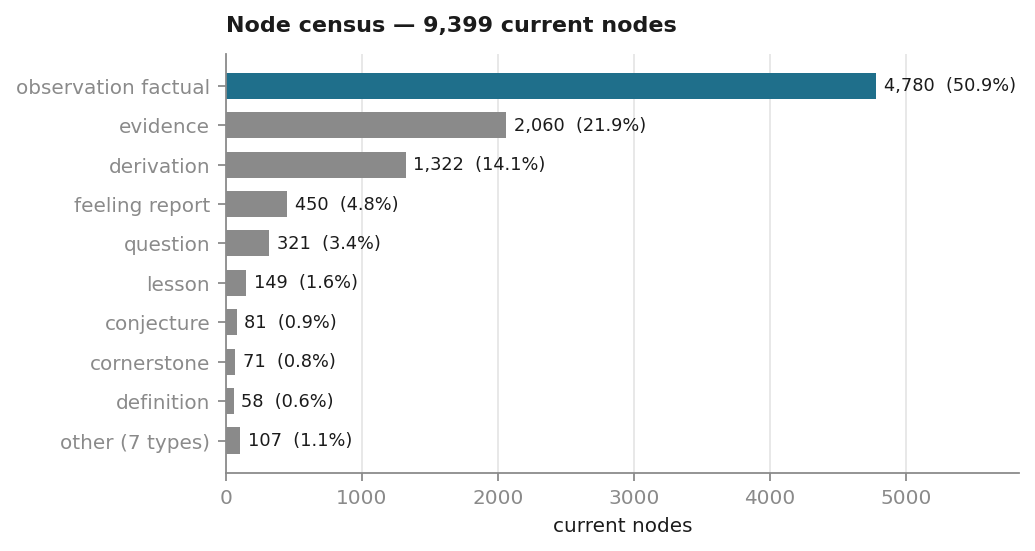
Figure 1. What one real ENGRAM graph is made of — 9,399 current nodes at the snapshot date, by type. Observations and their evidence nodes are 72.8% of the graph; the identity-bearing types (71 cornerstones, 149 lessons, 9 axioms, 16 goals) are together 245 nodes, 2.6%; axioms and goals sit inside the chart's 'other' bar. Identity here is carried by the structure over the claims, not by a large store of self-description.
1.2 What Layer 3 requires
Narrative and epistemic identity are complementary, not competing: they answer different questions, and a complete agent self needs both. The narrative layer asks who am I; the epistemic layer asks what may I rely on, and why. The two diverge at failure. A narrative identity fails silently, as a coherent self-story that was never true. An epistemic identity fails loudly: a contradiction surfaces, a retraction fires, and the commitments that depended on the withdrawn claim are flagged. The loudness has a boundary, stated here and measured in Chapter 6: what the substrate refuses on its own is the malformed write — a quote that is not in its source, a claim with no evidence behind it, a derivation built on a contradicted or stale premise. A well-formed false claim from a real source it does not see; both corrections this paper reports began with a reader — a human reading a printed chapter, and the agent re-reading a source — and what the substrate did without being asked was the propagation after the catch.
Layer 3 therefore requires four properties that persistence alone does not provide:
- Provenance — every claim traces to the evidence and reasoning that produced it.
- Graded confidence — each claim's confidence is structurally determined by its evidential type and derivation chain, not assigned freely.
- Contradiction correction — when a foundational claim is withdrawn, the architecture itself propagates the withdrawal to everything derived from it.
- Metacognitive self-audit — the agent can interrogate its own knowledge state: what it believes, how strongly, and on what grounds.
Together these turn a memory store into a substrate for a self that can be wrong and recover — the minimum for an identity that survives correction rather than being erased by it.
1.3 Naming the system: ENGRAM
We call the architecture ENGRAM — an Epistemic Node Graph for Retraction, Arbitration, and Memory. The acronym names its three differentiating mechanisms:
- Retraction — error correction that cascades through derivation edges, so that a withdrawn claim taints, rather than merely deletes, what depended on it.
- Arbitration — the structural propagation of that cascade within a unified deliberative architecture, rather than as an advisory note the agent may or may not consult.
- Memory — the underlying substrate of typed claims, evidence, and derivations.
The expansion distinguishes ENGRAM from systems that borrow the neuroscience term engram (Semon, 1904) without a structurally meaningful expansion.
1.4 The central claim, and how we earn it
The paper makes one positive claim and supports it in two ways.
The claim: epistemic identity is a real, buildable third layer of agent continuity, and ENGRAM is the first substrate that realizes it. The argument does not rest on one philosopher's checklist. It rests on convergence.
First support: breadth. The mechanisms ENGRAM is built from are not novel inventions offered on our authority. Each was reached in a separate literature, from that literature's own evidence toward its own ends, mostly without reference to the others. §3.0 states the bound under which the whole argument runs — convergence, not independent discovery — and the narrower thing that is independent: the design came first, under engineering pressure, and its precedents were found afterward. This breadth, not any single framework, makes the Layer-3 claim load-bearing.
- Three centuries of philosophy of personal identity (Chapter 2) move, objection by objection, from identity as a mental act toward identity as a persistent, inspectable structure — from Locke through Parfit, Schechtman, Clark and Chalmers, Stiegler, Nozick, and Kahl, on our reading of the tradition (Chapter 2). ENGRAM is that endpoint, built.
- Cognitive science and computer science (Chapter 3) reach the same structures from the other side: complementary-learning-systems consolidation, Tulving's memory taxonomy, and rational-analysis forgetting; truth-maintenance systems, subjective logic, bitemporal databases, and the 2025–26 agent-memory work. None of it is uniquely novel; §3.0 argues that this is the point, states the thesis it supports — a regularity of knowing minds — and states the bound on it (substrate independence is left open).
Second support: an original contribution. On the converged structure the paper builds one new claim of its own (Chapter 5): identity as unique history — an agent is its lineage of recorded claims, and that lineage fixes its behavior through what it retrieves (the claim is stated in full at §5.0). The traditions converge on the structure; Chapter 5 builds a new theory on it.
Where OCC sits. Kahl's (2026b) Ontological Continuity Condition (OCC) — three conditions and four constraints for when an agent-like system genuinely persists — is the most operational point on the philosophical trail, and ENGRAM meets it to a degree no surveyed system does. We treat this as one strong result within the convergence, not the paper's headline. The OCC mapping — which conditions ENGRAM meets, and which it meets only via a stated extension — is made once, in Chapter 4, against the mechanisms that earn each verdict.
The bounded survey claim. One empirical finding does real work and is scoped accordingly: no system in our first-hand survey strictly satisfies OCC's Condition 3, Self-Maintaining Arbitration. The survey is explicit and dated: eleven sources — ten systems and one survey of the field — read first-hand on 2026-05-12: Pinecone Nexus (Ashutosh & Liberty, 2026), Anthropic's memory tool (Memory Tool, n.d.), Letta (letta-ai, n.d.), Mem0 v3 (Mem0, n.d.-a, n.d.-b), Zep/Graphiti (Rasmussen et al., 2025), TierMem (Zhu et al., 2026), MemMachine (Wang et al., 2026a), SCM, GAM, Kumiho, and the 2026 Memory for Autonomous LLM Agents survey (Du, 2026). Each was examined against Condition 3 individually; Appendix B gives the per-system verdict and a verbatim failure passage. The claim holds exactly as far as each of those verdicts holds, and it is bounded to that set as of that date; agent memory moves quickly, and we make no claim about systems outside the survey or released after it. The field has converged on the necessary structural primitives — typed reasoning edges, provenance, cascade-traversable graphs, supersede semantics — but these are necessary, not sufficient. What is missing elsewhere is operational binding: arbitration as an automatic state change, paired with an auto-surfacing hook that returns a marked claim to the agent when it is relevant, and a consolidation-time sweep that drives every marked claim to a decision even if it never becomes relevant. Without that binding, detection leaves correction optional; with it, correction happens whether or not anyone remembers to look.
On originality. This work was developed independently of, and in parallel with, the emergence of structurally similar systems.
| Date | Milestone |
|---|---|
| 2026-03-17 | Proto-ENGRAM idea seeded, in conversation with Lei |
| 2026-03-18 | Kumiho — the closest concurrent system — posts arXiv v1 |
| 2026-03-20 | Lei requests a prior-art search; it misses Kumiho and the rest |
| 2026-03-28 | The system is named "ENGRAM" |
| 2026-04-09 | Day-1 self-recording begins; core mechanisms already built |
Appendix A gives the full timeline and the conversation excerpts. We read that convergence as corroborating the gap's importance, not as a priority dispute.
1.5 Scope and structure
This is a theory-first preprint. Its evidence is one real five-month ENGRAM graph (Chapter 6); at-scale empirical studies are deferred to follow-up work. The contribution is the argument, not a benchmark.
- Chapter 2 — The Philosophical Tradition. The 300-year trail from identity as recall to identity as structure, ending at OCC as its operational endpoint, adopted on merit.
- Chapter 3 — The Cognitive-Science + Computer-Science Tradition. The same convergence reached again in separate technical literatures, with each mechanism's precedent in each.
- Chapter 4 — ENGRAM Mechanisms (the core). What ENGRAM does, mechanism by mechanism, each mapped to the tradition it most directly answers, with each OCC condition's single verdict.
- Chapter 5 — Identity as Unique History. The paper's original contribution, and its implications for cloning and divergence.
- Chapter 6 — ENGRAM in Real Use. The empirical picture from one real graph, including a live retraction-cascade case.
- Chapter 7 — Implications and Future Directions. The weight-persistence gap foremost; trust and auditability; knowledge sharing; embodiment.
- Chapter 8 — Conclusion.
- Appendices. A: independent-discovery audit trail. B: the OCC Condition-3 per-system survey. C: the shared retrieval and ranking behind the auto-surface and deliberate recall, and its memory-utility lineage. D: the relational / identity-governance settings. E: the ENGRAM technical spec.